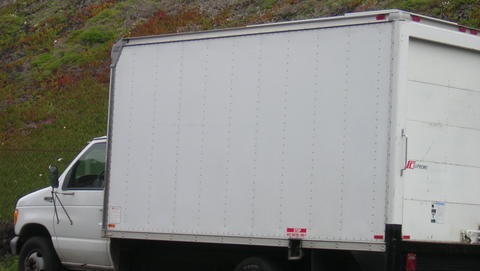
I've met about a half-dozen fellow vandwellers over the past few years, and I'm surprised by how sedentary we are. Almost all of the vandwellers I've met spend most of their time within a mile of where they have their storage units. Not a whole lot of travelling going on. Surprising because living in a van is a set up that seems ideal for travel. But we're not travelling, we're just a bunch of homebodies, it seems.
I've seen many more vandwellers around, who I haven't met, but again they're always parked within a block or two-- not even a mile-- of the same place, all the time. And again I find this interesting. A "mobile" lifestyle that isn't a whole lot more mobile than someone in a stick house. Over the last 6 months or so, I've tried to be more mobile, and enjoyed it a lot. But when I'm in town, I stick to the same places a lot. I guess I'm just as sedentary by nature as the rest of the vandwellers I've met or seen around.
Saturday, October 31, 2009

Sunday, October 25, 2009
Accelerations at constant throttle
I've figured out what most astounds and delights me about having all this power now that my fuel system is cleaned up.
When I hold the throttle constant, the van accelerates. A lot. It's great. It rarely did that, usually only when I'd just inflated the tires, then it would stop doing it over time. Now it does this all the time: I hold the throttle constant, and the van stays at constant revs, but it keeps going faster and faster on the road... and then it shifts, into even slower revs! Fuel efficiency, yes, we like it. And it even does this going up a hill.
I did a lot of little maintenance this weekend. I put some Parr-Bond, thanks to the suggestion of Possum from the vandweller's list, on the leak where the roof of the cab meets the front wall of the box. Parr-Bond is basically airplane glue. Works out well for the tight areas and the vertical areas, but up at the top where the seam is horizontal, there's also a huge gap, and the Parr-Bond is runny, so it just runs into the crack rather than sealing it. So that needs to get fixed, somehow.
I also discovered a deeply-pitted spot on the van cab roof, where water pools up. I cleaned it off and primered it. Over the next day or two I will enamel it.
I put in the new starter I've been carrying around for almost 2 years now. Sadly, it turned out not to be a gear-reduction starter, just the regular stock starter, so the van doesn't start any easier than it did before. But it was a simple job once I obtained the right kind of wrench (17mm C wrench, or an S-wrench will do in a pinch).
It is very weird how this van is half metric, half SAE. A vandweller friend gave me a caliper, which is very useful: I see a bolt, I measure it, I don't have to fish around for the right socket or wrench.
I am still baffled by the leak under the van. I looked yesterday, and saw a golden-brown drop clinging to a random peice of metal-- the unmistakable look and viscocity of motor oil. Biodiesel won't hang from a surface that long, for sure. I found another spot that was definitely leaking fuel before I changed out the hoses and o-rings, but is once again wet now! So maybe I still have a fuel leak, and an oil leak also.
To find the leaks, I will need to take off the turbo so I can see back in there. The oil leak may be coming from the turbo itself, its o-rings, or perhaps from the fuel pump which is buried behind the turbo. I sure hope it isn't the fuel pump: a new one is $400!
I made some progress planning the interior. The most important thing I need is the ceiling. Nothing can really happen until I get that ceiling in, and I'm having a very hard time locating ceiling tiles and hangers. I still have to mount the remaining lockers, but I need to get the ceiling in first. Then I can move cabinets around, move my batteries around, and start running conduit for a more permanent electrical setup-- something I definitely want. I'm also eager to put in a kitchen counter ($10/foot, not bad) and the sink I have had sitting around for a while. Something as simple as a sink would be a joy right now. I will re-do my bed with 2x2's instead of 2x6's, and put in a closet for clothes and stuff... lots of plans.
But right now I'd like to not be leaving puddles of fuel or oil or whatever all over the road.
When I hold the throttle constant, the van accelerates. A lot. It's great. It rarely did that, usually only when I'd just inflated the tires, then it would stop doing it over time. Now it does this all the time: I hold the throttle constant, and the van stays at constant revs, but it keeps going faster and faster on the road... and then it shifts, into even slower revs! Fuel efficiency, yes, we like it. And it even does this going up a hill.
I did a lot of little maintenance this weekend. I put some Parr-Bond, thanks to the suggestion of Possum from the vandweller's list, on the leak where the roof of the cab meets the front wall of the box. Parr-Bond is basically airplane glue. Works out well for the tight areas and the vertical areas, but up at the top where the seam is horizontal, there's also a huge gap, and the Parr-Bond is runny, so it just runs into the crack rather than sealing it. So that needs to get fixed, somehow.
I also discovered a deeply-pitted spot on the van cab roof, where water pools up. I cleaned it off and primered it. Over the next day or two I will enamel it.
I put in the new starter I've been carrying around for almost 2 years now. Sadly, it turned out not to be a gear-reduction starter, just the regular stock starter, so the van doesn't start any easier than it did before. But it was a simple job once I obtained the right kind of wrench (17mm C wrench, or an S-wrench will do in a pinch).
It is very weird how this van is half metric, half SAE. A vandweller friend gave me a caliper, which is very useful: I see a bolt, I measure it, I don't have to fish around for the right socket or wrench.
I am still baffled by the leak under the van. I looked yesterday, and saw a golden-brown drop clinging to a random peice of metal-- the unmistakable look and viscocity of motor oil. Biodiesel won't hang from a surface that long, for sure. I found another spot that was definitely leaking fuel before I changed out the hoses and o-rings, but is once again wet now! So maybe I still have a fuel leak, and an oil leak also.
To find the leaks, I will need to take off the turbo so I can see back in there. The oil leak may be coming from the turbo itself, its o-rings, or perhaps from the fuel pump which is buried behind the turbo. I sure hope it isn't the fuel pump: a new one is $400!
I made some progress planning the interior. The most important thing I need is the ceiling. Nothing can really happen until I get that ceiling in, and I'm having a very hard time locating ceiling tiles and hangers. I still have to mount the remaining lockers, but I need to get the ceiling in first. Then I can move cabinets around, move my batteries around, and start running conduit for a more permanent electrical setup-- something I definitely want. I'm also eager to put in a kitchen counter ($10/foot, not bad) and the sink I have had sitting around for a while. Something as simple as a sink would be a joy right now. I will re-do my bed with 2x2's instead of 2x6's, and put in a closet for clothes and stuff... lots of plans.
But right now I'd like to not be leaving puddles of fuel or oil or whatever all over the road.
Saturday, October 17, 2009
The Italian tune-up
After all the tank cleanup work, I drove the van to get some biodiesel. It was running like crap-- no power, shifting late. Pedal to the floor, 55MPH on the freeway. Not good.
I filled up, still running poorly. Maybe my filter is plugged up from when I ran the tank down to empty? Maybe there's a vapor lock or bubble somewhere? Maybe I messed up by removing that little bag from the filler cap? Lots of questions, no answers.
I took it on the freeway to head to the suburbs, and got frustrated, decided to just gun it and keep it there. After about a minute, I had power, lots of it! The old Italian tune-up did the trick: beat it up, wind it out, push it hard.
The fuel lines are very long, going from the front to behind the rear axle, so my best guess was air in the fuel lines, or possibly some gunk still in there.
After doing that, I could feel the power even at idle, which was a very odd sensation. I'm not sure how to describe it. Not so much a sound as a feeling, as if the engine's stroke became more vigorous. I'm familiar with gasoline big-block muscle cars rumbling ominously at stop lights, but here was my biodiesel van chugging away aggressively with way more power than it needed, tons of torque at idle speed.
And still leaking what smells like engine oil now. Rain coming this week, so no major work scheduled. I'll patch a few water leaks in the cab roof tomorrow, finally, before the next rain starts. Might try to figure out what size wrenches I might need to do the starter too.
I filled up, still running poorly. Maybe my filter is plugged up from when I ran the tank down to empty? Maybe there's a vapor lock or bubble somewhere? Maybe I messed up by removing that little bag from the filler cap? Lots of questions, no answers.
I took it on the freeway to head to the suburbs, and got frustrated, decided to just gun it and keep it there. After about a minute, I had power, lots of it! The old Italian tune-up did the trick: beat it up, wind it out, push it hard.
The fuel lines are very long, going from the front to behind the rear axle, so my best guess was air in the fuel lines, or possibly some gunk still in there.
After doing that, I could feel the power even at idle, which was a very odd sensation. I'm not sure how to describe it. Not so much a sound as a feeling, as if the engine's stroke became more vigorous. I'm familiar with gasoline big-block muscle cars rumbling ominously at stop lights, but here was my biodiesel van chugging away aggressively with way more power than it needed, tons of torque at idle speed.
And still leaking what smells like engine oil now. Rain coming this week, so no major work scheduled. I'll patch a few water leaks in the cab roof tomorrow, finally, before the next rain starts. Might try to figure out what size wrenches I might need to do the starter too.
Anderson powerpoles
On a recommendation from Ron on the vandweller list, I purchased some Anderson PowerPole connectors.
I love these. I spent hours this evening building switched powerpole jacks for electronics and utilities, and replacing a few cigarette-ligher cables and hard-wired cables with the new connectors.
I also organized a lot of my electronics parts, which have been just dumped randomly in drawers for years. I'm eager to get my electrical situation squared away in my living space: running conduit and putting in both 12v powerpole and standard 110v outlets in a few useful places.
I will head to a boneyard and try to find an RV with 12v flourescent light fixtures I can buy used. I like my "Super Bright LEDs" for general lighting, but for actually working on things (i.e. electronics), I need a 15W or 30W flourescent. If I'm doing my math right, that should be only a couple amps of draw; I have plenty of solar electrical, and I wouldn't need that much light all the time anyway.
I also want to create a weatherized 110V and 12V jack and place it under the box. Would make it easier to plug in lights and tools when working on the truck. My flourescent work light is indispensible. A 12V cigarette lighter would be especially helpful for plugging in my air compressor, so that I can keep my rear tire pressure up to spec.
I love these. I spent hours this evening building switched powerpole jacks for electronics and utilities, and replacing a few cigarette-ligher cables and hard-wired cables with the new connectors.
I also organized a lot of my electronics parts, which have been just dumped randomly in drawers for years. I'm eager to get my electrical situation squared away in my living space: running conduit and putting in both 12v powerpole and standard 110v outlets in a few useful places.
I will head to a boneyard and try to find an RV with 12v flourescent light fixtures I can buy used. I like my "Super Bright LEDs" for general lighting, but for actually working on things (i.e. electronics), I need a 15W or 30W flourescent. If I'm doing my math right, that should be only a couple amps of draw; I have plenty of solar electrical, and I wouldn't need that much light all the time anyway.
I also want to create a weatherized 110V and 12V jack and place it under the box. Would make it easier to plug in lights and tools when working on the truck. My flourescent work light is indispensible. A 12V cigarette lighter would be especially helpful for plugging in my air compressor, so that I can keep my rear tire pressure up to spec.
Fuel tank cleaned!
My fuel tank is now clean. I obtained a 5 gal tote of biodiesel, and then ran my tank down to empty (on the freeway, which sucked, I had to pull over and put in a couple gallons to get moving again). Today I opened the drain plug in the tank, pulled out the sender unit, and drained everything. I wasn't parked on a perfectly even surface, so I had to use my 12v accessory pump to suck out the remaining fuel. There were 2 gallons of really lousy fuel. Water, glycerin, and some rust. The sender unit on this aft-of-axle 37-gal tank is 6" in diameter, so I was able to see in the tank, and also to get my whole arm in there, to wipe off the inside with a clean rag.
The tank wasn't rusted really badly, just a few spots of rust starting at the welds for the drain plug, and a thin layer of what looked like rust (but could have been residue of melted rubber fuel hose) on the baffles. I cleaned it all up as thoroughly as I could.
The tank is an interesting design: it has a spiral baffle, a few inches tall, that leads up to the sender unit. It's galvanized steel, which can get destroyed by bacteria that grows in water in biodiesel and attacks the zinc-- but in this case I hadn't much corrosion. The biggest annoyance was the glycerin and water from some bad fuel I bought last year from a guy who made the stuff in his basement. Nowadays I buy only ASTM approved biodiesel from any of the three commercial retail filling stations around the Bay Area that carry it. The right thing would be to use a plastic tank, which I now own and will eventually install.
I feel much better having this tank clean. The stock filler hose was rubber, and it was weeping fuel from a joint between the filler cap and the tank. So I threw it away and replaced it with a new vynil 1.5" ID hose.
I RTV'ed the cover for the flywheel-- the stock paper gasket had disintegrated and Ford doesn't sell the gaskets anymore. That might help me track down leaks better. There's still a very small leak or two on the engine, as well as the transmission and differential seals. I'm on a long-term mission to have a leak-free vehicle.
In a perfect world, I would have done all this BEFORE starting to drive the vehicle with biodiesel. Instead I deferred it for 10,000 miles, which isn't a lot. It's getting done though, and that makes me feel a lot more confident.
The tank wasn't rusted really badly, just a few spots of rust starting at the welds for the drain plug, and a thin layer of what looked like rust (but could have been residue of melted rubber fuel hose) on the baffles. I cleaned it all up as thoroughly as I could.
The tank is an interesting design: it has a spiral baffle, a few inches tall, that leads up to the sender unit. It's galvanized steel, which can get destroyed by bacteria that grows in water in biodiesel and attacks the zinc-- but in this case I hadn't much corrosion. The biggest annoyance was the glycerin and water from some bad fuel I bought last year from a guy who made the stuff in his basement. Nowadays I buy only ASTM approved biodiesel from any of the three commercial retail filling stations around the Bay Area that carry it. The right thing would be to use a plastic tank, which I now own and will eventually install.
I feel much better having this tank clean. The stock filler hose was rubber, and it was weeping fuel from a joint between the filler cap and the tank. So I threw it away and replaced it with a new vynil 1.5" ID hose.
I RTV'ed the cover for the flywheel-- the stock paper gasket had disintegrated and Ford doesn't sell the gaskets anymore. That might help me track down leaks better. There's still a very small leak or two on the engine, as well as the transmission and differential seals. I'm on a long-term mission to have a leak-free vehicle.
In a perfect world, I would have done all this BEFORE starting to drive the vehicle with biodiesel. Instead I deferred it for 10,000 miles, which isn't a lot. It's getting done though, and that makes me feel a lot more confident.
Friday, October 16, 2009
The simple pleasures
I'm discovering the joy of the simple pleasures in life-- the inexpensive everyday luxuries.
For example, I've been suffering for nearly a year with a Colemaan camping cast-iron pot for cooking in. It gets dirty, it's hard to clean, it has no handle so it's really difficult to deal with, it slips off of the Coleman burner if I'm not careful, it dribbles steam down the side of the pot, etc etc.
A few weeks ago I was at a Chinese supermarket getting some food, and walked past a whole aisle full of pots and pans, for really cheap. I thought, well why not just get one? I did.
I'm so glad I did too! For all of $8, my meals are pleasant. It has a handle. It has a glass lid so I can see what I'm cooking. It's coated with Teflon, so cleaning it up takes all of 5 seconds-- just wipe it down! Essential for vandwelling. It has a rough surface on the bottom so it doesn't slip off of the stove-- also a great safety feature in a van. It has a little metal washer and hole in the glass lid, so that steam escapes through it instead of around the sides of the pot-- no more mess on the burner. And it is a thinner metal so it heats up much faster.
All these little joys, from one very cheap purchase! The things that make life pleasant are not hard, nor are they expensive. I just have to keep an eye out for them.
For example, I've been suffering for nearly a year with a Colemaan camping cast-iron pot for cooking in. It gets dirty, it's hard to clean, it has no handle so it's really difficult to deal with, it slips off of the Coleman burner if I'm not careful, it dribbles steam down the side of the pot, etc etc.
A few weeks ago I was at a Chinese supermarket getting some food, and walked past a whole aisle full of pots and pans, for really cheap. I thought, well why not just get one? I did.
I'm so glad I did too! For all of $8, my meals are pleasant. It has a handle. It has a glass lid so I can see what I'm cooking. It's coated with Teflon, so cleaning it up takes all of 5 seconds-- just wipe it down! Essential for vandwelling. It has a rough surface on the bottom so it doesn't slip off of the stove-- also a great safety feature in a van. It has a little metal washer and hole in the glass lid, so that steam escapes through it instead of around the sides of the pot-- no more mess on the burner. And it is a thinner metal so it heats up much faster.
All these little joys, from one very cheap purchase! The things that make life pleasant are not hard, nor are they expensive. I just have to keep an eye out for them.
Tuesday, October 13, 2009
Warm, dry, quiet, and safe
It's raining up a huge storm, and I'm happily encamped in a quiet suburban area, safe, warm, and dry in my huge aluminum can.
Since it's raining and I'm not doing any work on the engine or fuel system until the rain stops, I'm planning the next steps for the interior: a countertop (at last!), a sink, and a more permanent mounting for the cooler, water supply, and propane stove. Turns out that laminate countertops are cheap, about $10/foot new, possibly even available for free, and easy to cut holes in.
Since it's raining and I'm not doing any work on the engine or fuel system until the rain stops, I'm planning the next steps for the interior: a countertop (at last!), a sink, and a more permanent mounting for the cooler, water supply, and propane stove. Turns out that laminate countertops are cheap, about $10/foot new, possibly even available for free, and easy to cut holes in.
Subscribe to:
Posts (Atom)