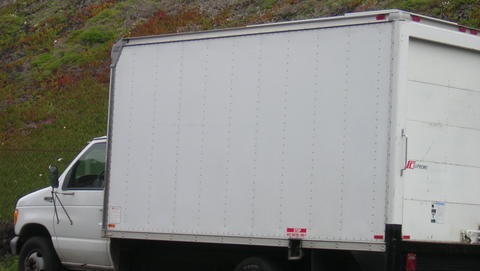
I've noted here before that I'm getting pretty good at picking parking spaces that are to leeward of some major obstacle: a hill, a mountain, a large office building, etc. That helps me sleep, by not get my van smacked around by the high winds we've been having. And I'm also staying upwind from freeways and other sources of pollution, which makes me healthier.
But I've discovered another interesting thing. It's a lot quieter too. I didn't realize the degree that wind carries sound. If I'm near a freeway, and I'm either upwind or on the leeward side of a building from it, then I don't hear it hardly at all.
Days of high winds, there's more highway noise all around. Calmer days are just quieter.
Wind carries sound like it carries odors? Really? I don't understand the physics of it, but so far my experiments indicate that this is indeed what happens.
Wednesday, February 10, 2010

Thursday, February 4, 2010
Buzzzzz
A vandwelling friend had some trouble with his laptop. Laptops tend to fry when you run them with the power on and when the battery is fully charged-- I ruined an old Sony VAIO that way. The charging circuitry doesn't like that, and tends to fry the dc-dc converter inside the unit. The DC-DC converter is usually a set of surface-mount components, not easy to R/R, and usually means replacing the motherboard, which of course on a laptop is pretty close to the same cost as just replacing the laptop.
Now that my van is so quiet, with the new ceiling, and the sunshine is back again, as I'm sitting here in the van working on my netbook, I notice a crackling sound coming from the powersupply section of the netbook. I am running my netbook directly off of my solar, since the netbook wants 12v and my solar electrical system is 12v. But wait. It's not 12v; the solar charger just sends battery voltage out, it doesn't regulate it. So, in sunshine, with my house batteries charged, my netbook is getting anywhere up to 14.1V! Not too smart, and could be frying all kinds of components. May have been doing so for a year, but it's been so damn noisy in here that I haven't noticed the complaints from the switching DC-DC converter inside the unit.
I unplug the laptop from my house batteries. The crackling sound goes away. Drat.
Some quick online shopping locates an external power adapter/regulator (which is, basically, a DC-DC converter itself), to give me regulated 12v, for $15 including shipping. Off goes the credit card, and I'm done. It's possible I've been frying my netbook for the last year. So far, no signs of damage, but I'm not going to risk it any longer. $15 is a lot cheaper than $300.
Now that my van is so quiet, with the new ceiling, and the sunshine is back again, as I'm sitting here in the van working on my netbook, I notice a crackling sound coming from the powersupply section of the netbook. I am running my netbook directly off of my solar, since the netbook wants 12v and my solar electrical system is 12v. But wait. It's not 12v; the solar charger just sends battery voltage out, it doesn't regulate it. So, in sunshine, with my house batteries charged, my netbook is getting anywhere up to 14.1V! Not too smart, and could be frying all kinds of components. May have been doing so for a year, but it's been so damn noisy in here that I haven't noticed the complaints from the switching DC-DC converter inside the unit.
I unplug the laptop from my house batteries. The crackling sound goes away. Drat.
Some quick online shopping locates an external power adapter/regulator (which is, basically, a DC-DC converter itself), to give me regulated 12v, for $15 including shipping. Off goes the credit card, and I'm done. It's possible I've been frying my netbook for the last year. So far, no signs of damage, but I'm not going to risk it any longer. $15 is a lot cheaper than $300.
Tuesday, February 2, 2010
./configure; make; make install
Just opened up and checked my fuel tank; it's clean. So I finally changed the fuel filter, after it had been plugged with disintegrated rubber sludge. I also put in a new fuel heater since the old one had fallen apart; that might be helpful next winter.
The engine is running somewhat better now, but the engine computer is very confused since the running conditions have changed. I'll give it another dozen or so miles and see how it goes, but it certainly does seem to have more power now with a clean filter and no more sludge in the system.
Checking the fuel tank, and even draining it, took an hour. Changing the filter this time took a couple hours. It's becoming routine. I know how to get the air filter off in the most efficient way, get to the fuel filter, lube up the threads, etc etc. This has to be the 5th fuel filter I've put in within two years. No more homemade fuel for me! From now on, it's only ASTM-grade commercial biodiesel.
I'm almost at the point where the maintenance work is routine. It's become like the "./configure; make; make install" dance to compile software on Linux, which I've been doing for a decade now and is second nature.
It's very similar to diesel mechanical maintenance. Most of the time it's routine, but there can be all kinds of crazy stuff that goes wrong if you don't have everything together, and knowing what to do in that case requires expertise. I remember the first time I did it-- either compiling software or doing maintenance on my truck--, there was all kinds of drama and crazy things going wrong that I didn't know how to fix, and turned the whole procedure into a huge, long, drawn-out nightmare. But no more. I can compile software, get it to run, and fix bugs that prevent it from compiling, often without much thought. I can do most of the maintenance required on the truck now, and it's routine and drama-free, most of the time, just because I've done it enough times now to know how to prevent things going wrong, and what to do if it does.
And now, I've got to get to work on my actual work, what I started living in a van in order to be able to do. The means is nearing completion, now it is time to focus on the ends.
The one small distraction is that I still have to reconfigure my living/working space for more efficiency and to give me more time for my work, and more convenience in my life. And I'm almost there with that too. Good times.
The engine is running somewhat better now, but the engine computer is very confused since the running conditions have changed. I'll give it another dozen or so miles and see how it goes, but it certainly does seem to have more power now with a clean filter and no more sludge in the system.
Checking the fuel tank, and even draining it, took an hour. Changing the filter this time took a couple hours. It's becoming routine. I know how to get the air filter off in the most efficient way, get to the fuel filter, lube up the threads, etc etc. This has to be the 5th fuel filter I've put in within two years. No more homemade fuel for me! From now on, it's only ASTM-grade commercial biodiesel.
I'm almost at the point where the maintenance work is routine. It's become like the "./configure; make; make install" dance to compile software on Linux, which I've been doing for a decade now and is second nature.
It's very similar to diesel mechanical maintenance. Most of the time it's routine, but there can be all kinds of crazy stuff that goes wrong if you don't have everything together, and knowing what to do in that case requires expertise. I remember the first time I did it-- either compiling software or doing maintenance on my truck--, there was all kinds of drama and crazy things going wrong that I didn't know how to fix, and turned the whole procedure into a huge, long, drawn-out nightmare. But no more. I can compile software, get it to run, and fix bugs that prevent it from compiling, often without much thought. I can do most of the maintenance required on the truck now, and it's routine and drama-free, most of the time, just because I've done it enough times now to know how to prevent things going wrong, and what to do if it does.
And now, I've got to get to work on my actual work, what I started living in a van in order to be able to do. The means is nearing completion, now it is time to focus on the ends.
The one small distraction is that I still have to reconfigure my living/working space for more efficiency and to give me more time for my work, and more convenience in my life. And I'm almost there with that too. Good times.
Saturday, January 23, 2010
Ceiling, bearings, leaks
Just another update. I have finally, FINALLY, after two years, put my ceiling in. It's all there now: dropped ceiling, LED lights embedded in, electrical buried in conduit above it, and pink fiberglass insulation stuffed in the plenum. It was ridiculously, mindlessly simple and straightforward-- took me a couple hours including cleaning everything up. That's it-- I'd been procrastinating for years, and it took me a few hours to do.
Now it's quiet in here. REALLY quiet. What a joy! It's like being inside a house, or the body of a really well-insulated modern car. It's very pleasant, home-like. I can still hear what's going on around me, but it's not deafening anymore. The beer-can-thin sheet aluminum just wasn't any kind of insulation; it was like literally living out on the street. At least now it's quiet, and warmer. At last, I have a home.
I had a little emergency last week with my rear bearings. They were destroyed, and burnt up, from driving around on bent rear wheels. That little disaster cost me $700! I have to stop jumping curbs when making tight turns, or just parking stupidly. I'm now shopping for used wheels and some newer used tires. Hopefully very soon-- before I destroy my new $700 bearings. Ouch. One step forwards, three steps backwards: that's how my life goes. I'm OK with that now.
I also finally received the correct metal fuel return lines in the mail from GreaseWorks, as well as Viton short supply hoses, and put them in! Very expensive, but they at least are the correct hoses for biodiesel now. The fuel leaks appear to be over-- for the time being at least, and possibly for good. I had to do that job in the pouring rain and with a bad flu, but it had to get done.
I mounted a little plastic tupperware underneath the inspection cover, to catch drips and leaks. So far so good. There is still some kind of leak dribbling down, but it appears at this time to be oil, not fuel. Possibly from just a poorly-sealing oil pan gasket, or maybe it's from the turbo, I dunno, but it's minor and I'll deal with it when I deal with it.
The engine runs MUCH better now, since there is no longer melted-rubber sludge circulating through the fuel system. Actually, there still is, and I am going to ruin one more fuel filter between now and when that all gets cleaned out. But it idles evenly and has a lot more power. Once I run my tank low again, I have to drain the tank yet again and clean out all that sludge-- hopefully for the last time. The challenge will be coordinating all that with the rainy weather; crawling around on the ground under the fuel tank is very unpleasant in a rainstorm.
The only remaining rubber that I have to replace which contacts biodiesel, are the injector seals. I have all the tools and parts to do that job; now I just need to block out the time and summon the courage to do it.
I purchased the proper coolant to replace all my current coolant, as well as SCA test strips and the correct DC4 pH additive. Before I do that job, first of all I have to find a place to dump the old coolant, but also I've got to track down why my heater doesn't work. If it's a simple matter of reattaching a flap open/close wire, that's great. If I have to pull the heater core, I might as well wait to change the coolant at the same time. The hoses leading to the heater appear to be warm, so I hope that means that it's not plugged.
I'm also going to replace my transmission fluid and filter, but that's waiting until some of the more high-priority stuff is done. This is all basic maintenance I should have done two years ago, and I'm just getting to now. Buying a used vehicle that has been poorly-maintained or unmaintained is a bad idea in the first place, but if I do ever do such a thing again, I'm personally, myself, changing all the fluids and filters immediately upon buying it, not counting on some shop to do it or not.
I'm also eager to move my bed to its new position and put in my sink and counter, and mount my cabinets. I expect these to be fairly easy jobs, and they will make my life infinitely more pleasant. I've got to take care of the wheels first, though.
Now it's quiet in here. REALLY quiet. What a joy! It's like being inside a house, or the body of a really well-insulated modern car. It's very pleasant, home-like. I can still hear what's going on around me, but it's not deafening anymore. The beer-can-thin sheet aluminum just wasn't any kind of insulation; it was like literally living out on the street. At least now it's quiet, and warmer. At last, I have a home.
I had a little emergency last week with my rear bearings. They were destroyed, and burnt up, from driving around on bent rear wheels. That little disaster cost me $700! I have to stop jumping curbs when making tight turns, or just parking stupidly. I'm now shopping for used wheels and some newer used tires. Hopefully very soon-- before I destroy my new $700 bearings. Ouch. One step forwards, three steps backwards: that's how my life goes. I'm OK with that now.
I also finally received the correct metal fuel return lines in the mail from GreaseWorks, as well as Viton short supply hoses, and put them in! Very expensive, but they at least are the correct hoses for biodiesel now. The fuel leaks appear to be over-- for the time being at least, and possibly for good. I had to do that job in the pouring rain and with a bad flu, but it had to get done.
I mounted a little plastic tupperware underneath the inspection cover, to catch drips and leaks. So far so good. There is still some kind of leak dribbling down, but it appears at this time to be oil, not fuel. Possibly from just a poorly-sealing oil pan gasket, or maybe it's from the turbo, I dunno, but it's minor and I'll deal with it when I deal with it.
The engine runs MUCH better now, since there is no longer melted-rubber sludge circulating through the fuel system. Actually, there still is, and I am going to ruin one more fuel filter between now and when that all gets cleaned out. But it idles evenly and has a lot more power. Once I run my tank low again, I have to drain the tank yet again and clean out all that sludge-- hopefully for the last time. The challenge will be coordinating all that with the rainy weather; crawling around on the ground under the fuel tank is very unpleasant in a rainstorm.
The only remaining rubber that I have to replace which contacts biodiesel, are the injector seals. I have all the tools and parts to do that job; now I just need to block out the time and summon the courage to do it.
I purchased the proper coolant to replace all my current coolant, as well as SCA test strips and the correct DC4 pH additive. Before I do that job, first of all I have to find a place to dump the old coolant, but also I've got to track down why my heater doesn't work. If it's a simple matter of reattaching a flap open/close wire, that's great. If I have to pull the heater core, I might as well wait to change the coolant at the same time. The hoses leading to the heater appear to be warm, so I hope that means that it's not plugged.
I'm also going to replace my transmission fluid and filter, but that's waiting until some of the more high-priority stuff is done. This is all basic maintenance I should have done two years ago, and I'm just getting to now. Buying a used vehicle that has been poorly-maintained or unmaintained is a bad idea in the first place, but if I do ever do such a thing again, I'm personally, myself, changing all the fluids and filters immediately upon buying it, not counting on some shop to do it or not.
I'm also eager to move my bed to its new position and put in my sink and counter, and mount my cabinets. I expect these to be fairly easy jobs, and they will make my life infinitely more pleasant. I've got to take care of the wheels first, though.
Wednesday, January 13, 2010
Ceiling good good good
I'm very happy to report that with only half the ceiling tiles in, and no insulation even stuffed in the gap yet, it's a LOT quieter in here! It's so quiet I can even hear the fan running on my netbook. It's also a lot warmer, and, for some reason, a lot drier. Perhaps the ceiling tiles are absorbing moisture, I don't know.
But either way, it feels a lot more like a home: a lot more comfortable, peaceful, livable. I wish I'd done this 2 years ago, but I didn't know what I was doing back then.
Same with the van maintenance: the leak is gone, and I'm on to the next set of issues like replacing injector seals, changing out fluids (transmission, coolant) that have probably never been changed, and longevity-oriented preventitive maintenance.
It's been said about painting a car, that once you've finished the project, you know enough to start it. I guess that's true about the massive projects I took on two years ago and am finally getting settled into: vandwelling, Ford 7.3L diesel repair and maintenance, biodiesel conversion, building out an interior of a custom RV, and a massive self-improvement project too.
But either way, it feels a lot more like a home: a lot more comfortable, peaceful, livable. I wish I'd done this 2 years ago, but I didn't know what I was doing back then.
Same with the van maintenance: the leak is gone, and I'm on to the next set of issues like replacing injector seals, changing out fluids (transmission, coolant) that have probably never been changed, and longevity-oriented preventitive maintenance.
It's been said about painting a car, that once you've finished the project, you know enough to start it. I guess that's true about the massive projects I took on two years ago and am finally getting settled into: vandwelling, Ford 7.3L diesel repair and maintenance, biodiesel conversion, building out an interior of a custom RV, and a massive self-improvement project too.
Sunday, January 10, 2010
Lots of progress
Just an update. I have been very busy these past few weeks.
I removed my fuel bowl and replaced all the O-rings. Getting some of them back on properly was very difficult and I was lucky to have some help when I got stuck. I put everything back together, and, I don't mean to jinx it but it does look like it's finally stopped leaking.
The new fuel return hoses I just put on in September are already melting from the exposure to biodiesel; I finally ordered braided metal/Teflon(tm) fuel lines from a biodiesel shop. When they arrive I'll put them in and be done with external fuel leaks.
The inside of my fuel bowl was filthy. I'm not sure with what. It's either rubber from the melting hoses, or more likely, oil from my completely shot injector o-rings. I already have the o-rings; I just ordered the special tools I'll need to remove the injectors and replace the o-rings. I'm scared of doing it, but I have to do it. Once it's done, every single o-ring on this vehicle which contacts fuel will have been replaced. At last. And I should be able to continue run biodiesel for as long as I can get it, without problems.
I also torqued down my transmission pan bolts; about half of them were almost two turns loose! No wonder I was losing fluid.
And I completed an oil change. It needed one since I've been driving this vehicle abusively: short couple-mile-long trips on a cold engine. For this oil change I was somewhat less of an idiot and didn't overfill the crankcase. I filled it up exactly correctly by accident. My crankcase takes 3.5 gallons of oil, not the 4.5 gallons I thought it did. So I "partially" filled it with 3.5 gallons, then started it up to check the dipstick to see how much I needed to top it up. Zero was the answer: it was already at the maximum of the full line. Next time I'll actually consult my notes before doing the job.
I also fixed my custom rear door so that it slides without scraping the floor (and kind of fits better), put a new tire on my bike so I can ride it again, adjusted its brakes and shifting so I can now get all the gears, finished mounting all my conduit, and... put in 1/2 of my ceiling tiles!! It's beautiful. I'm not even done yet, but can sit here and it's quiet enough that I can hear the fan on my netbook. And I've been busy with work-related tasks, all of which are going smoothly.
It feels like I've made a major breakthrough in my life very recently. I'm starting to learn how to "think like a German": to handle problems and tasks analytically and somewhat coldly and detachedly, to plan ahead, work in an orderly and clean fashion, to approach things with more confidence and without fear. It works.
I removed my fuel bowl and replaced all the O-rings. Getting some of them back on properly was very difficult and I was lucky to have some help when I got stuck. I put everything back together, and, I don't mean to jinx it but it does look like it's finally stopped leaking.
The new fuel return hoses I just put on in September are already melting from the exposure to biodiesel; I finally ordered braided metal/Teflon(tm) fuel lines from a biodiesel shop. When they arrive I'll put them in and be done with external fuel leaks.
The inside of my fuel bowl was filthy. I'm not sure with what. It's either rubber from the melting hoses, or more likely, oil from my completely shot injector o-rings. I already have the o-rings; I just ordered the special tools I'll need to remove the injectors and replace the o-rings. I'm scared of doing it, but I have to do it. Once it's done, every single o-ring on this vehicle which contacts fuel will have been replaced. At last. And I should be able to continue run biodiesel for as long as I can get it, without problems.
I also torqued down my transmission pan bolts; about half of them were almost two turns loose! No wonder I was losing fluid.
And I completed an oil change. It needed one since I've been driving this vehicle abusively: short couple-mile-long trips on a cold engine. For this oil change I was somewhat less of an idiot and didn't overfill the crankcase. I filled it up exactly correctly by accident. My crankcase takes 3.5 gallons of oil, not the 4.5 gallons I thought it did. So I "partially" filled it with 3.5 gallons, then started it up to check the dipstick to see how much I needed to top it up. Zero was the answer: it was already at the maximum of the full line. Next time I'll actually consult my notes before doing the job.
I also fixed my custom rear door so that it slides without scraping the floor (and kind of fits better), put a new tire on my bike so I can ride it again, adjusted its brakes and shifting so I can now get all the gears, finished mounting all my conduit, and... put in 1/2 of my ceiling tiles!! It's beautiful. I'm not even done yet, but can sit here and it's quiet enough that I can hear the fan on my netbook. And I've been busy with work-related tasks, all of which are going smoothly.
It feels like I've made a major breakthrough in my life very recently. I'm starting to learn how to "think like a German": to handle problems and tasks analytically and somewhat coldly and detachedly, to plan ahead, work in an orderly and clean fashion, to approach things with more confidence and without fear. It works.
Monday, January 4, 2010
The Black Sludge
I think I have figured out why my van was running like crap: uneven idling, lack of power, hard starting.
I decided to have a look and see why my van is still leaking fuel. I saw that the fuel bowl still appears to be leaking from every orefice (except the ones I filled with new seals). So I decided it's time to pull the bowl again, and this time replace all the seals, not just a few, and do a total fuel bowl rebuild.
I hooked up the handy-dandy new drain hose I put on the bottom of the vehicle, positioned a container under it, and opened the drain plug on the fuel bowl. Boy do I wish I'd done that months ago. A full pint of pitch-black sludge started coming out.
Rubber. My "new" hoses are melting. The fuel bowl was probably dangerously filled with this black sludge, but my "Water in Fuel" light wasn't coming on because rubber isn't conductive, and the water-in-fuel sensor works by testing for the conductivity of water.
I pull the filter. Plugged up and filthy, after only a couple thousand miles. I am a little worried about what damage this might have done to my injectors.
The fuel return lines are literally disintegrating: melting, sweating from the outside. Based on the sludge content of the filter, the insides of these hoses must look even worse. The brand-new ones after only a few months are already in the same condition that the old ones were after nearly two years. Scary, and frustrating.
I located and ordered, from GreaseWorks.com, a proper biodiesel-rated fuel line kit. Expensive: $125, but still less than I spent on the WRONG hoses back in September. I will put a few new but completely inadequate hoses on, just to buy me some time until the correct hoses arrive in the mail (should be next week).
After the correct hoses arrive and are installed, the game plan will be to run the engine for a while on the new filter and new hoses, then run the tank down to empty, drain it, clean out the rubber sludge that no doubt is collecting at the bottom of it, run it some more to filter out all that crap, and finally to change the filter yet again. And... if I did all the right things, not change that filter again for another 30,000 miles or whatever the spec is.
This is my fifth filter in two years. At $35 a pop. I really hope to have finally gotten this right.
I decided to have a look and see why my van is still leaking fuel. I saw that the fuel bowl still appears to be leaking from every orefice (except the ones I filled with new seals). So I decided it's time to pull the bowl again, and this time replace all the seals, not just a few, and do a total fuel bowl rebuild.
I hooked up the handy-dandy new drain hose I put on the bottom of the vehicle, positioned a container under it, and opened the drain plug on the fuel bowl. Boy do I wish I'd done that months ago. A full pint of pitch-black sludge started coming out.
Rubber. My "new" hoses are melting. The fuel bowl was probably dangerously filled with this black sludge, but my "Water in Fuel" light wasn't coming on because rubber isn't conductive, and the water-in-fuel sensor works by testing for the conductivity of water.
I pull the filter. Plugged up and filthy, after only a couple thousand miles. I am a little worried about what damage this might have done to my injectors.
The fuel return lines are literally disintegrating: melting, sweating from the outside. Based on the sludge content of the filter, the insides of these hoses must look even worse. The brand-new ones after only a few months are already in the same condition that the old ones were after nearly two years. Scary, and frustrating.
I located and ordered, from GreaseWorks.com, a proper biodiesel-rated fuel line kit. Expensive: $125, but still less than I spent on the WRONG hoses back in September. I will put a few new but completely inadequate hoses on, just to buy me some time until the correct hoses arrive in the mail (should be next week).
After the correct hoses arrive and are installed, the game plan will be to run the engine for a while on the new filter and new hoses, then run the tank down to empty, drain it, clean out the rubber sludge that no doubt is collecting at the bottom of it, run it some more to filter out all that crap, and finally to change the filter yet again. And... if I did all the right things, not change that filter again for another 30,000 miles or whatever the spec is.
This is my fifth filter in two years. At $35 a pop. I really hope to have finally gotten this right.
Subscribe to:
Posts (Atom)